
Last updated September 10, 2026
Full 25-point door and opener safety check with every visit - springs, cables, rollers, tracks, and your LiftMaster or Chamberlain opener included
You get a price before we start. It does not change when the truck arrives.
 Before
 After
After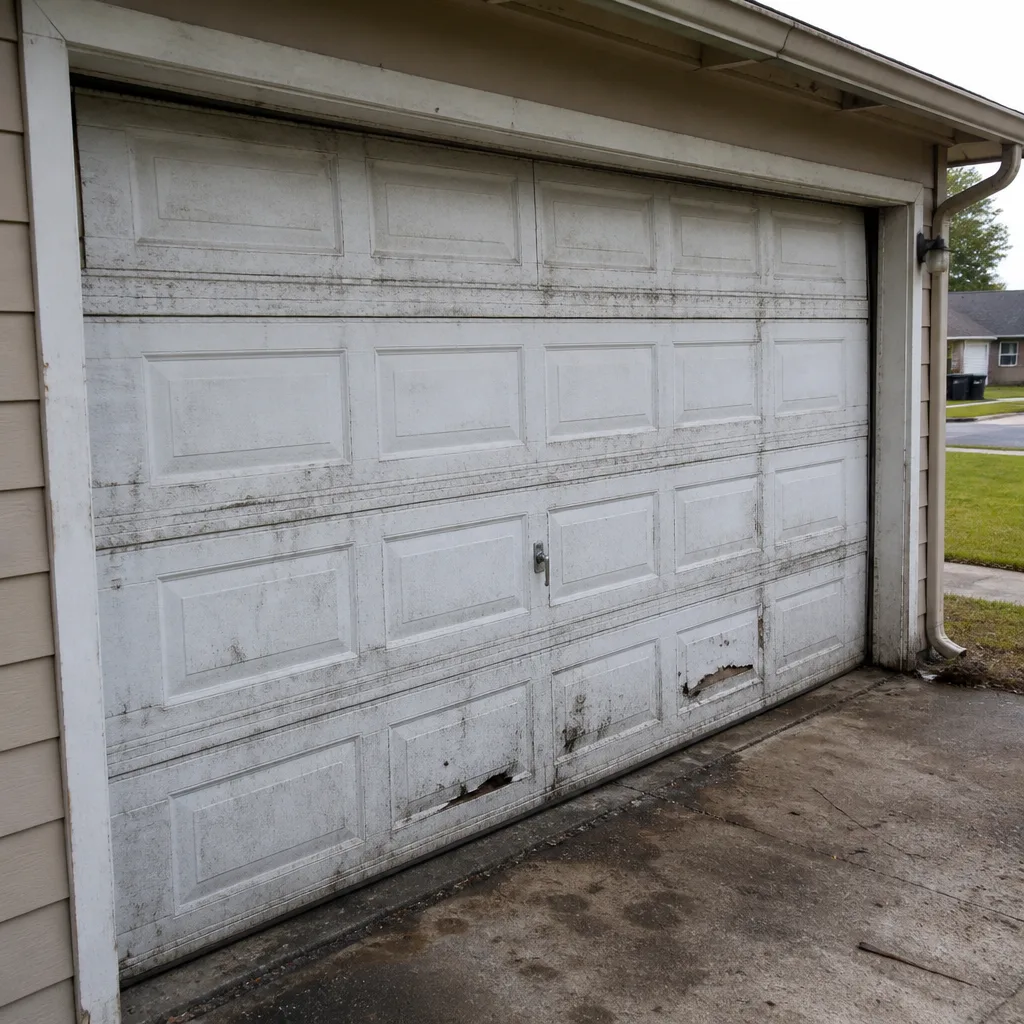 Before
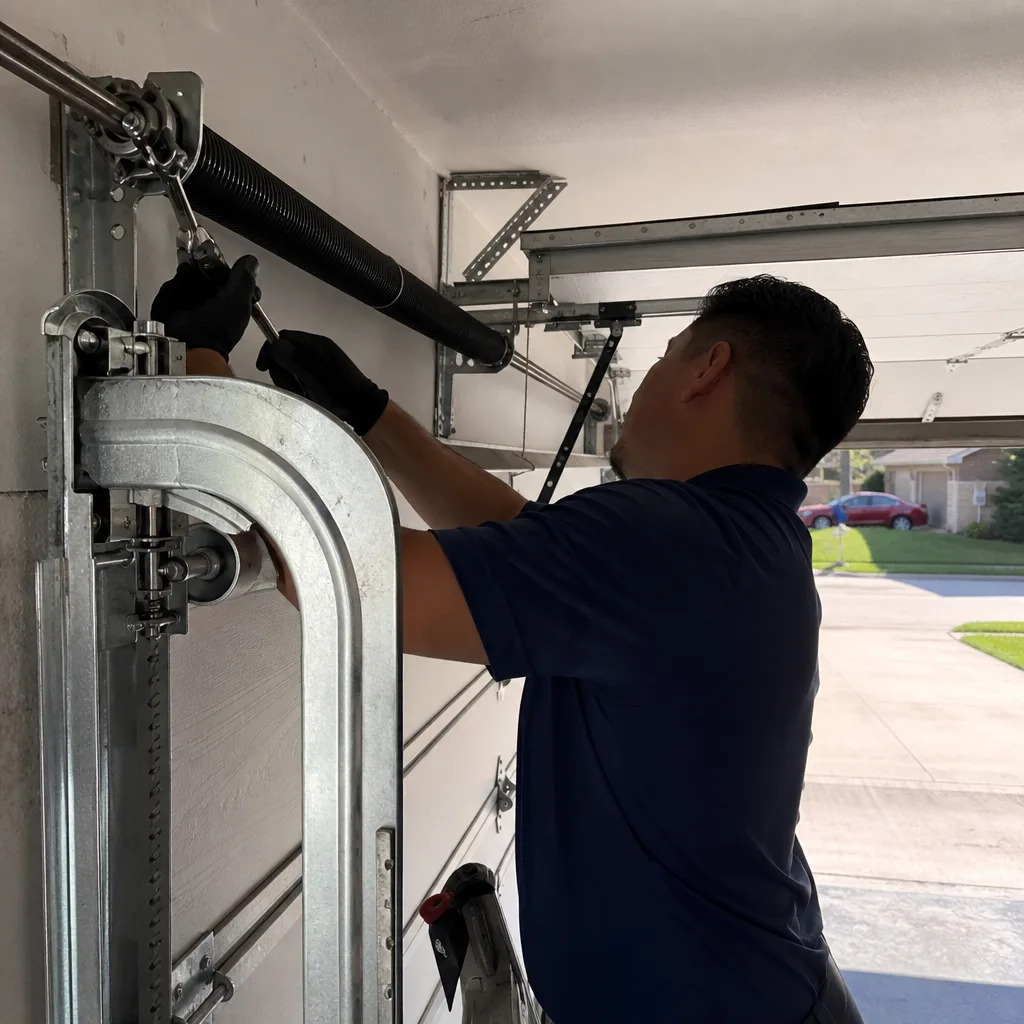 After
After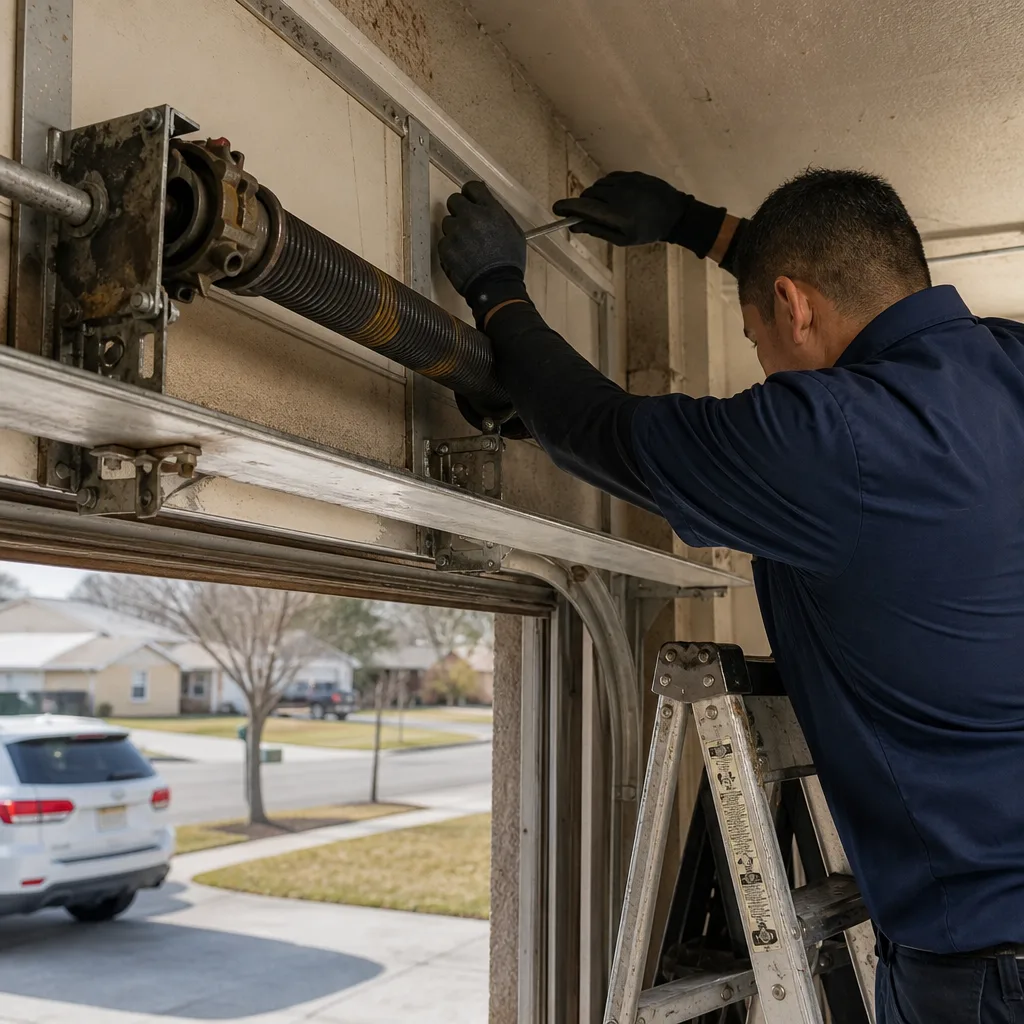 Before
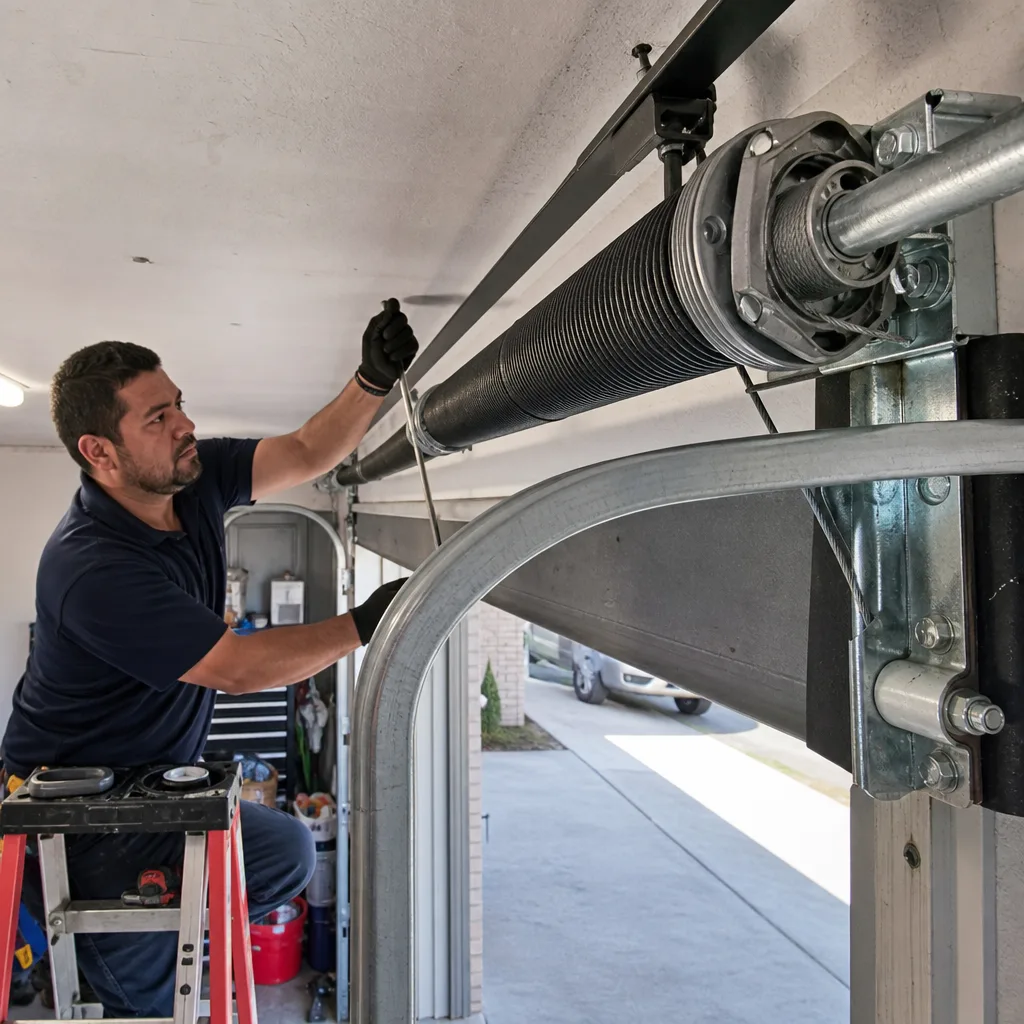 After
AfterGarage Door Warning Signs: A Baytown Homeowner’s Reference Guide
Most warning sign guides treat every symptom as an emergency. That is not how a door fails. A garage door that reverses unexpectedly is not always a sensor problem - it is sometimes a spring that has lost enough tension to register the door’s own weight as an obstacle, which is a different repair entirely. In our 42 years serving Baytown, we have learned that homeowners who can triage accurately save money, avoid panic, and know when a door truly needs to stop operating today. This guide - along with The Complete Guide to Garage Door in Baytown - teaches you to sort symptoms into three clear categories: Stop Now, Schedule Soon, and Watch It.
Quick Answer
The most serious garage door warning signs in Baytown are a door that falls when released from the opener, a broken spring with visible gap, and cables that have slipped off the drum - all three require stopping use immediately. Grinding or slow operation, weather seal deterioration, and minor remote inconsistency are schedule-soon issues that can wait for a planned appointment. Slight panel fading, cosmetic rust spots, and quiet clicking at startup are watch-it items to monitor during your seasonal garage door care check.
Table of Contents
- The Three Stop-Now Signs: When to Stop Using Your Door Today
- Schedule-Soon Signs: Problems That Need a Planned Appointment
- Watch-It Signs: What to Monitor Without Worry
- Two Warning Signs Baytown Homeowners Most Often Misread as Cosmetic
- How to Tell a Worn Spring From a Worn Cable From a Failing Opener
- What Heavy Rain and Ground Shifting Reveal About Your Frame Versus Your Hardware
- When the Door Works Manually but Struggles on the Opener
- Common Mistakes to Avoid
- When to Call a Professional
- Frequently Asked Questions
- The Bottom Line
The Three Stop-Now Signs: When to Stop Using Your Door Today
These three conditions present genuine safety hazards. Continuing to operate the door risks property damage, personal injury, or sudden catastrophic failure.
Sign 1: The Door Falls or Drops When Released From the Opener
A properly balanced garage door should stay where you leave it when disconnected from the opener. If you pull the red emergency release handle and the door slides down the tracks on its own, the spring system has failed or is near failure. The spring carries the full weight of the door - typically 150 to 400 pounds depending on size and material. Without that counterbalance, the opener strains, cables wear unevenly, and the door can slam without warning.
In Baytown’s humid climate, we see accelerated spring corrosion that homeowners do not notice until this exact test. The salt air from Galveston Bay accelerates surface rust on torsion springs, particularly in homes south of I-10 toward Beach City and Cove. If your door fails this balance test, stop using it. Do not attempt to adjust or replace springs yourself. Torsion springs store lethal energy. A wound spring can cause serious injury or death if handled improperly.
Sign 2: Visible Gap in a Torsion Spring
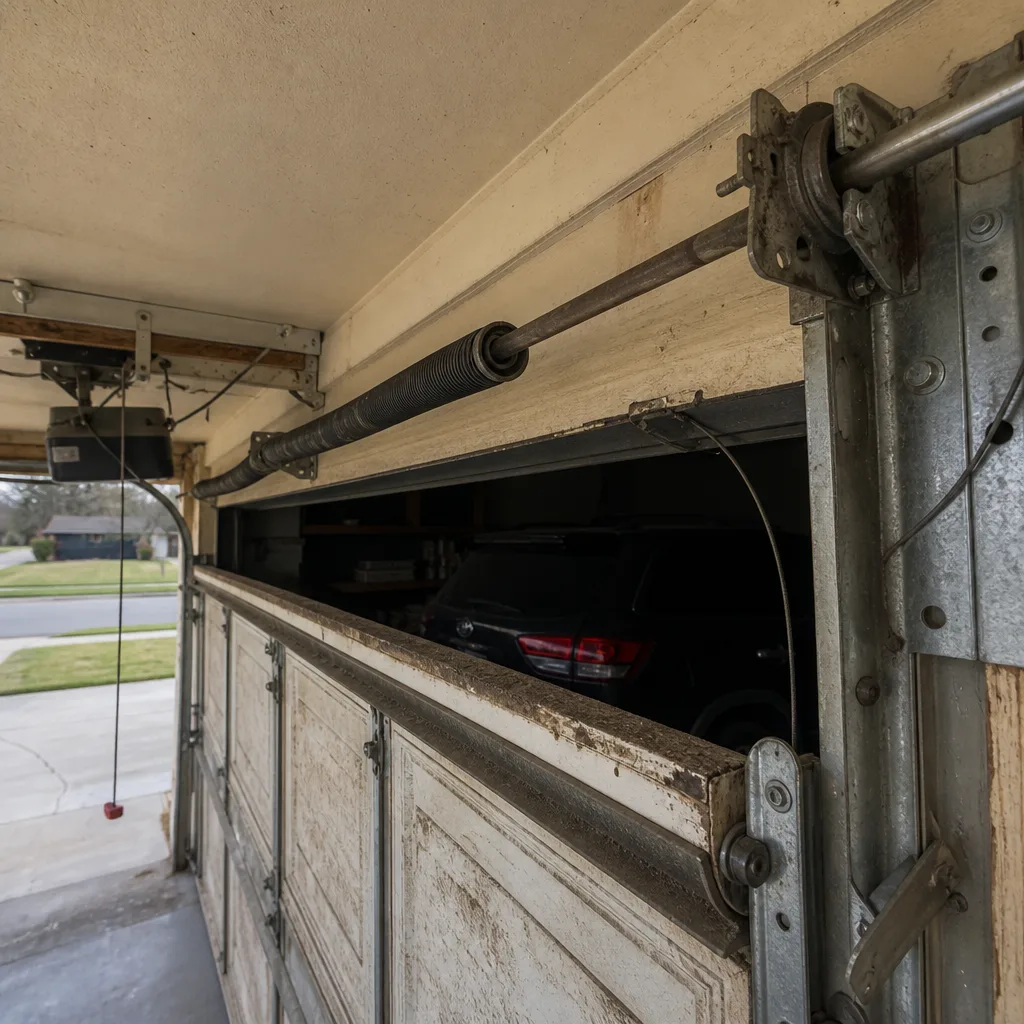
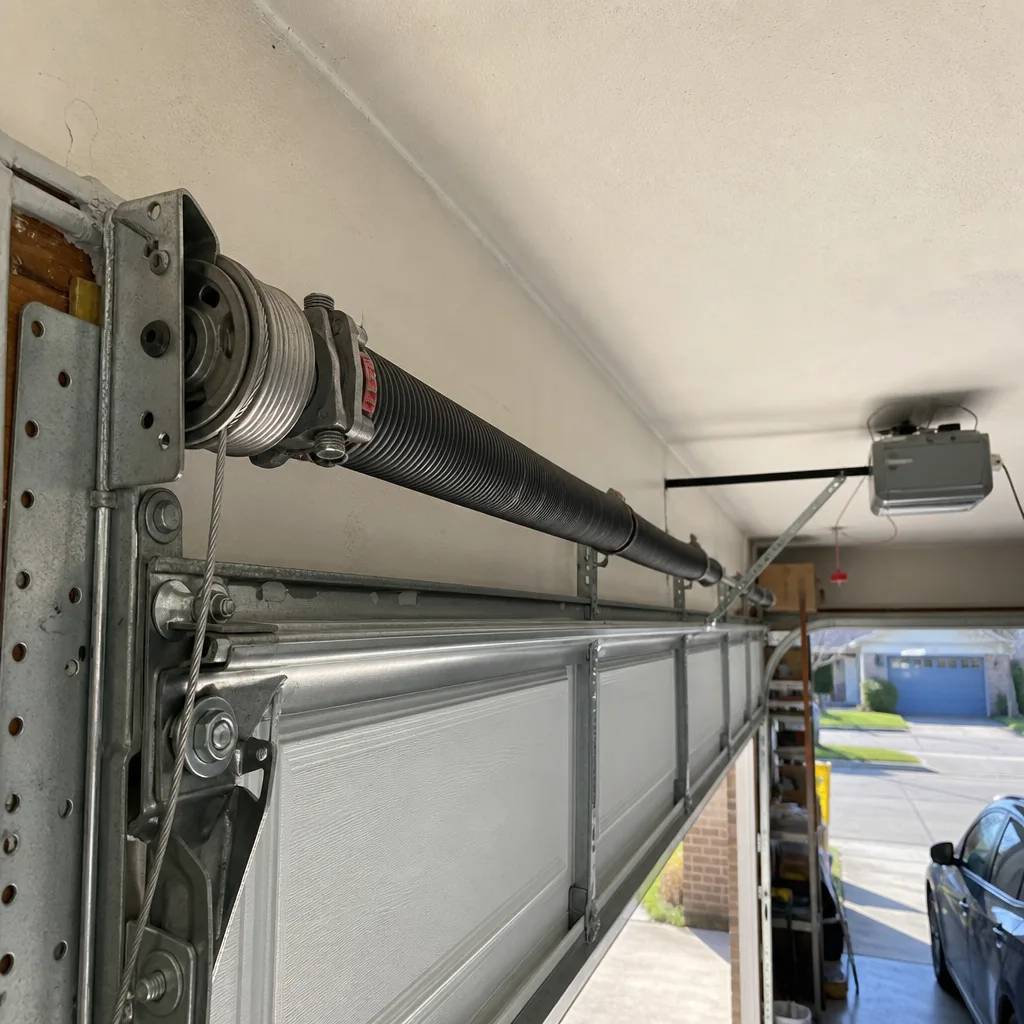
Torsion springs sit horizontally above the door opening. A healthy spring is a continuous coil. A gap of even an inch means the spring has broken internally. The door may still open if it has a two-spring system and the second spring is compensating, but it is operating under dangerous overload. The remaining spring will fail soon, and when it does, the door can drop violently.
We have responded to emergency calls in the Baytown Historic District where homeowners continued operating a door with one broken spring for weeks, not realizing the second spring was carrying double its designed load. The eventual failure damaged the door, the opener, and in one case, a vehicle parked beneath.
Sign 3: Cables Off the Drum or Frayed to the Core
Lift cables wind around drums at each end of the torsion tube. If a cable has slipped off its drum, the door hangs unevenly and can twist in the tracks. This jams the door and risks panel separation or track bending. Frayed cables are equally serious - a snapped cable under tension whips with enough force to lacerate.
Look for cables that hang loose, loop incorrectly around the drum, or show exposed wire strands. In our experience serving neighborhoods from Goose Creek Village to the Highlands, cable issues often follow spring failures, as the unbalanced load stresses the cable system beyond its design.
If you observe any of these three signs: Disengage the opener using the red emergency release cord. Lock the door manually if possible. Do not operate it again until a trained technician inspects the system.
Schedule-Soon Signs: Problems That Need a Planned Appointment
These conditions do not require immediate cessation of use, but they will worsen without attention. Schedule within one to two weeks.
Grinding, Screeching, or Metal-on-Metal Noise
Healthy door operation produces a low hum from the opener and smooth rolling from the rollers. Grinding or screeching indicates metal contact where lubrication or alignment has failed. Common sources include:
- Dry or worn rollers - steel rollers without ball bearings grind in their tracks; nylon rollers crack and chatter
- Misaligned track sections - often follows minor impact or foundation settling common in Baytown’s clay soils
- Worn opener gear assembly - a stripped gear produces a distinctive grinding before total failure
- Lack of lubrication on hinges, springs, or the opener rail
The distinction matters for repair planning. Roller replacement is straightforward. Gear assembly replacement requires opener-specific parts. Track realignment may indicate underlying structural movement. Our technicians carry rollers, hinges, and gear kits for all major brands including Wayne Dalton and Craftsman, so most grinding issues resolve in a single visit.
Slow or Hesitant Operation
A door that takes noticeably longer to open or pauses mid-cycle usually signals opener strain, spring fatigue, or track obstruction. Time your door - a standard 7-foot door should open in 12 to 15 seconds. Slower operation means the system is working harder than designed, which accelerates wear on all components.
In Baytown’s summer heat, opener motors run hotter and amplifiers can trigger thermal protection, causing hesitation. This is more common in uninsulated garages facing afternoon sun, particularly in newer developments like Marrs Meadows where garage orientation often exposes the door to western exposure.
Weather Seal Deterioration
The rubber seal along the door bottom and between panels keeps water, pests, and conditioned air out. Cracking, flattening, or daylight visible beneath the closed door means the seal has hardened or compressed. This is not an emergency, but it invites water intrusion during Baytown’s heavy spring rains and increases cooling costs when your garage abuts conditioned space.
We stock common seal profiles and can match most Amarr and Raynor door specifications from our trucks.
Remote Inconsistency or Range Reduction
If your remote works from the driveway but not the street, or requires multiple presses, the issue is typically the remote battery, opener antenna position, or interference from LED lighting or nearby electronics. Replace the battery first. If the problem persists, the opener’s logic board or radio receiver may be degrading. This is a schedule-soon item because total failure is inconvenient but not dangerous.
Panel Dents or Surface Damage That Affects Movement
A dented bottom panel that contacts the floor unevenly, or a creased middle panel that binds in the tracks, creates operational drag. The door may still function but stresses the opener and hardware. Schedule panel assessment - sometimes a panel replacement restores proper function without full door replacement.
Watch-It Signs: What to Monitor Without Worry
These conditions warrant observation during your seasonal tune-up but do not require immediate service.
- Slight panel fading or chalking: UV degradation of paint or finish. Cosmetic only unless surface cracking exposes metal to rust.
- Minor surface rust on tracks or hardware: Common in Baytown humidity. Wipe with dry cloth; address if pitting develops.
- Quiet clicking at startup: Often normal engagement of opener chain or belt drive. Concerning only if accompanied by operational change.
- Slight flex in horizontal track: All tracks have engineered tolerance. Monitor for increasing deflection.
- Remote battery indicator low: Replace the battery. Not a door problem.
We recommend the $89 Seasonal Tune-Up for Baytown homeowners who prefer not to monitor these items themselves; for those who do, see our more guides & resources. Our technicians inspect, lubricate, and report on all watch-it conditions during the visit.
Two Warning Signs Baytown Homeowners Most Often Misread as Cosmetic
Misread Sign 1: Gaps of Light Around the Door Perimeter
Homeowners see light leaking around a closed door and assume weather seal replacement will solve it. Sometimes it will. But uneven gaps - wider on one side, or growing progressively larger - often indicate frame shift or track mounting failure. Baytown’s expansive clay soils, particularly in areas north of Texas Avenue toward Cedar Bayou, produce seasonal foundation movement that transfers stress to garage door frames.
Check your gaps with the door closed and lights off inside. If the gap pattern is symmetrical and consistent, seal replacement is appropriate. If the gap is wider at one corner, or if the door appears to sit crooked in the opening, the frame or track mounting needs assessment. Ignoring this leads to roller binding, opener strain, and eventually track failure. We have replaced entire track systems in Baytown homes where a $200 frame adjustment would have sufficed if caught earlier.
Misread Sign 2: Paint Bubbling or Peeling on the Door Interior
Interior paint failure on a steel door signals moisture accumulation between the steel skin and any insulation layer. This is not merely cosmetic. Trapped moisture corrodes the steel from inside, weakens panel rigidity, and can delaminate insulation. The door becomes heavier, operates less smoothly, and eventually develops structural weakness at hinge points.
Baytown’s humidity, combined with temperature differentials between sun-heated exterior and air-conditioned garage interiors, creates ideal conditions for this hidden corrosion. We see it frequently in homes near the ship channel and in older Baytown subdivisions where original doors lack modern moisture barriers. If you notice interior paint bubbling, schedule inspection - panel replacement may be necessary before full door failure occurs.
How to Tell a Worn Spring From a Worn Cable From a Failing Opener
Three different failures can produce similar sounds. Accurate diagnosis prevents unnecessary parts replacement.
Step 1: Identify When the Sound Occurs
- Sound during manual operation (opener disconnected): Spring or cable issue. Opener is eliminated from consideration.
- Sound only during powered operation: Opener or drive system issue. Springs and cables may be fine.
- Sound at a specific point in the cycle: Track, roller, or hinge issue. Location-specific.
Step 2: Characterize the Sound
| Sound | Likely Source | Confirming Test |
|---|---|---|
| Loud bang or pop, then door stops or operates heavily | Broken torsion spring | Visual inspection of spring coil for gap |
| Squealing or groaning that changes with door position | Worn spring losing tension | Balance test - door should stay at any position when released |
| Slapping or thumping against track | Loose or frayed cable | Inspect cable tension and drum winding |
| Grinding with metal shavings visible near opener | Stripped opener gear | Disconnect door and run opener alone - grinding persists |
| Clicking or rattling in rhythm with chain/belt movement | Worn drive sprocket or loose chain | Inspect chain sag and sprocket teeth |
Step 3: Apply the Baytown Context
Our coastal humidity affects each component differently. Springs corrode from surface rust that penetrates to the core. Cables develop internal rust that is invisible until fraying appears. Openers suffer from circuit board corrosion at connection points, producing intermittent electrical faults that mimic mechanical failure. A technician familiar with local conditions, like our journeymen trained under the K.E.Y.S. values code, recognizes these patterns and tests appropriately rather than replacing parts speculatively.
We carry diagnostic equipment and replacement springs, cables, and opener components for all major brands on every truck. Most sound-diagnosis repairs in Baytown complete in a single visit with no return trip for parts.
What Heavy Rain and Ground Shifting Reveal About Your Frame Versus Your Hardware
Baytown receives 50 to 60 inches of annual rainfall, concentrated in spring and fall storms. This moisture, combined with the region’s expansive gumbo clay soils, creates specific diagnostic patterns.
After Heavy Rain: Frame Issues
If your door begins binding, rubbing at the top, or showing uneven gaps after sustained rain, the likely cause is soil expansion lifting or shifting the garage slab and frame. Clay soils swell when wet and exert pressure on foundation elements. The door frame, which is precisely fitted to the opening, has no tolerance for this movement.
Signs that point to frame rather than hardware:
- Problems appear or worsen within 24 to 48 hours of heavy rain
- Door operates normally in dry periods
- Gap pattern changes - wider at bottom after rain, for instance
- Visible crack in garage floor or wall near door opening
Frame-related binding requires structural assessment before hardware adjustment. Adjusting tracks to compensate for frame shift temporarily relieves symptoms but accelerates hardware wear and can damage the door.
After Heavy Rain: Hardware Issues
Moisture directly affects hardware through rust formation and lubrication washout. Signs that point to hardware:
- Gradual onset over days or weeks, not sudden after rain
- Noise increase - grinding, squeaking - as lubrication degrades
- Visible rust on springs, cables, or hardware
- Opener strain indicators - lights flashing, thermal shutdown
Hardware issues respond to proper rust treatment, component replacement, and appropriate lubrication. We use corrosion-resistant hardware and long-film lubricants suited to Gulf Coast conditions.
Ground-Shifting Events
Baytown’s industrial activity, including petrochemical facility operations, produces low-level ground vibration. Major construction or seismic events elsewhere on the Gulf Coast can also trigger minor settling. After any noticeable tremor or vibration event, test your door’s balance and observe for new operational changes. Early detection of shift-related problems prevents cascade failure.
When the Door Works Manually but Struggles on the Opener
This specific diagnostic pattern isolates the problem to the opener and its interaction with the door, not the door’s mechanical system itself. It is a valuable clue that homeowners often misinterpret as general “door problems.”
When a door moves smoothly by hand but labors, reverses, or stops under opener power, consider these causes:
- Opener force settings misaligned with actual door weight: Springs weaken gradually; the opener compensates by increasing force until it reaches limit. Eventually it cannot compensate enough. The door mechanics are fine - the spring-opener relationship is out of calibration.
- Worn opener drive components: Chain stretch, belt fraying, or gear tooth wear reduce mechanical advantage. The motor runs but effective power delivery declines. Manual operation bypasses this entirely.
- Failing opener motor or capacitor: Starting torque insufficient for load. Motor hums or strains. Capacitor failure is common in older openers, particularly in hot garage environments.
- Logic board interpreting normal resistance as obstruction: Sensitivity set too high, or board components degrading. The opener “thinks” it has hit something and reverses.
The critical point: replacing springs, cables, or rollers will not solve an opener-specific problem. Conversely, replacing an opener when the real issue is spring fatigue wastes money and masks a safety hazard. Our Garage Door Opener in Baytown service includes load testing and force calibration to distinguish these conditions accurately.
We see this misdiagnosis frequently in Baytown’s older homes, particularly in established neighborhoods like Roseland Terrace and Baywood, where original openers from the 1990s or early 2000s remain in service past their design life. A 25-year-old opener with a failing capacitor can produce symptoms identical to a door with worn springs. Testing both systems separately is essential.
Common Mistakes to Avoid
- Ignoring a door that reverses for “no reason”: This is never random. It indicates force imbalance, sensor misalignment, or track obstruction. Continued operation damages the opener and creates safety risk.
- Applying WD-40 to springs or tracks: This product is a solvent, not a lubricant. It removes existing grease and attracts dust. Use lithium-based or silicone garage door lubricant only.
- Adjusting torsion spring tension with a winding bar: Homeowners who attempt this without training risk severe injury. The stored energy in a wound spring can fracture bones or worse. This is not a DIY task.
- Replacing only one spring in a two-spring system: Springs age together. A new spring paired with an old spring creates dangerous imbalance and guarantees early failure of the remaining old spring.
- Assuming all grinding is “just old age”: Grinding is always a specific mechanical fault with a specific repair. Ignoring it converts a $200 roller replacement into a $800 opener and track rebuild.
- Waiting for total failure before calling: In Baytown’s summer heat, a failing opener can trap a vehicle inside when thermal protection shuts it down at the worst moment. Schedule-soon signs deserve timely attention.
- Choosing repair by lowest bid without verifying parts quality: Some competitors install generic springs with incorrect cycle ratings. A proper 10,000-cycle spring costs more upfront and lasts years longer. We specify cycle ratings on every quote.
When to Call a Professional
Call a trained garage door technician when you observe any Stop-Now sign, when schedule-soon symptoms persist beyond two weeks, or when you cannot confidently distinguish between the categories in this guide; if you’re unsure who to call, read How to Hire a Garage Door Contractor in Baytown: A Step-by-Step Guide. The cost of professional diagnosis is modest compared to the cost of cascade failure or personal injury.
Carl Dutton and the team at Mainspring Garage Door Co. home have served Baytown homeowners since 2016, building on a company foundation laid in 1984. We answer our phones with a live person 24 hours a day, arrive with the parts to complete most repairs in one visit, and state every price upfront before work begins. Our 90-Day Done Right Promise covers every completed job in writing - if it is not right, we return at no charge, no paperwork, no argument.
Mainspring Garage Door Co. offers free estimates in Baytown. Call (936) 246-0813 to schedule, or request a Garage Door Repair in Baytown assessment if you are unsure which category your symptom fits.
Frequently Asked Questions
Most common repairs in Baytown range from $150 to $450, with spring replacement typically at the lower end and opener replacement at the higher end. We provide exact, flat pricing before any work begins, and our $50 Off Any Repair Over $250 standing offer applies automatically. Call (936) 246-0813 for a free estimate with no obligation.
Broken torsion springs require replacement, not repair. A spring is a single, continuous coil of hardened steel. Once it breaks or loses temper, it cannot be restored to safe working condition. We install matched spring pairs with verified cycle ratings, and every spring replacement carries our 90-Day Done Right Promise.
The three most common causes are misaligned safety sensors, excessive friction in the door system triggering force limits, or weakened springs causing the opener to interpret normal door weight as an obstruction. Check that sensor LEDs are steady and aligned. If they are, the issue is likely mechanical and requires professional assessment of springs, rollers, and track condition.
We recommend annual professional service for Baytown homes, with additional inspection after severe weather events. Our $89 Seasonal Tune-Up includes balance testing, hardware inspection, lubrication, and safety system verification. The senior and veteran 5% discount applies to this service as well.
No. Our upfront pricing policy means the quoted price is the charged price. We diagnose, quote, and obtain your approval before any work begins. If we discover additional issues during repair, we stop and explain before proceeding. There are no surprises on the bill.
Yes. Our trucks are stocked with springs, cables, rollers, hinges, and opener components for all major brands including Wayne Dalton, Craftsman, Raynor, LiftMaster, Chamberlain, Genie, Clopay, and Amarr. For discontinued models, we source compatible replacements or advise on upgrade options. Most repairs complete in a single visit without waiting for parts.
The Bottom Line
Garage door warning signs fall into three clear categories. Stop-Now signs - falling doors, broken springs, and failed cables - demand immediate cessation of use. Schedule-Soon signs like grinding, slow operation, and weather seal failure need planned attention within two weeks. Watch-It signs require monitoring but not immediate service. The two most commonly misread signs, light gaps and interior paint bubbling, often indicate structural issues rather than cosmetic ones. Accurate sound diagnosis distinguishes spring, cable, and opener problems. Baytown’s clay soils and coastal humidity create specific patterns that experienced local technicians recognize. When in doubt, professional assessment costs less than misdiagnosis.
Written by Carl Dutton, Owner at Mainspring Garage Door Co., serving Baytown since 2016.