
Last updated September 10, 2026
Full 25-point door and opener safety check with every visit - springs, cables, rollers, tracks, and your LiftMaster or Chamberlain opener included
You get a price before we start. It does not change when the truck arrives.
 Before
 After
After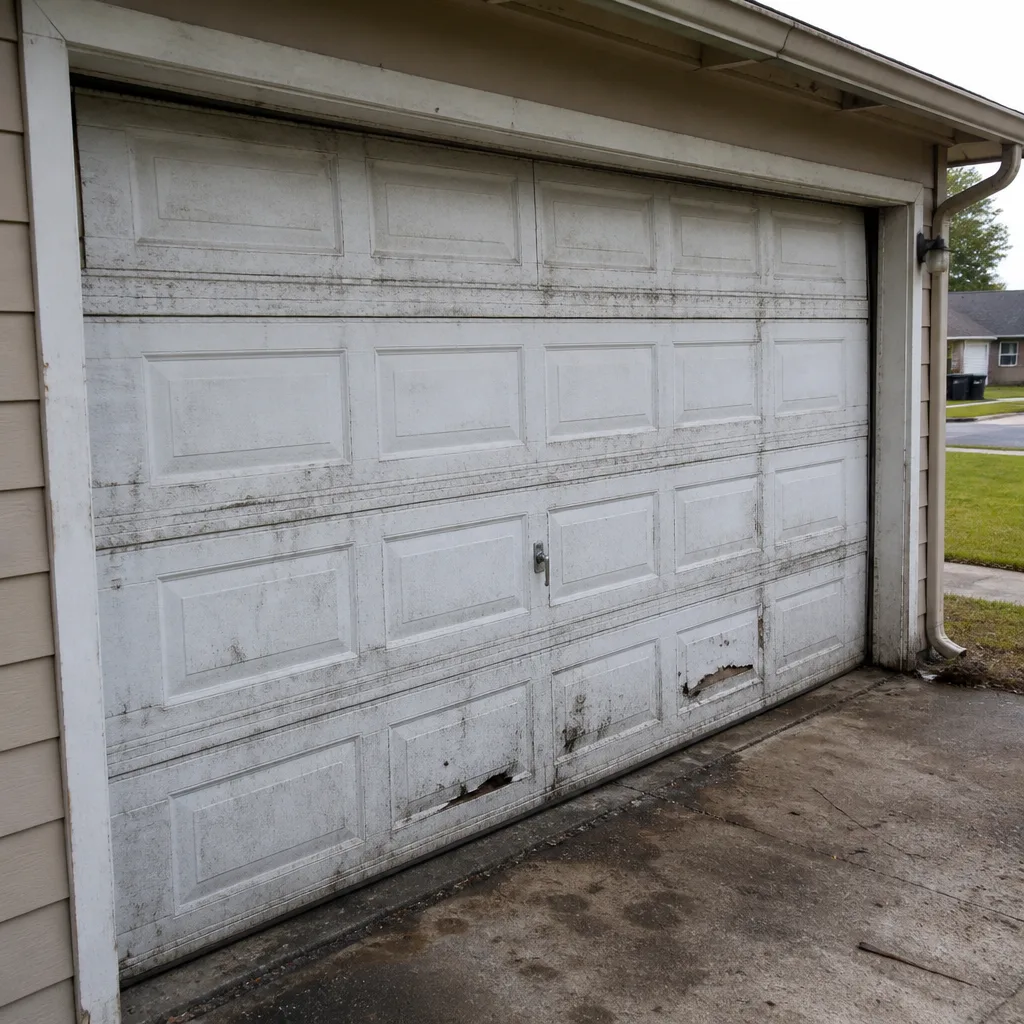 Before
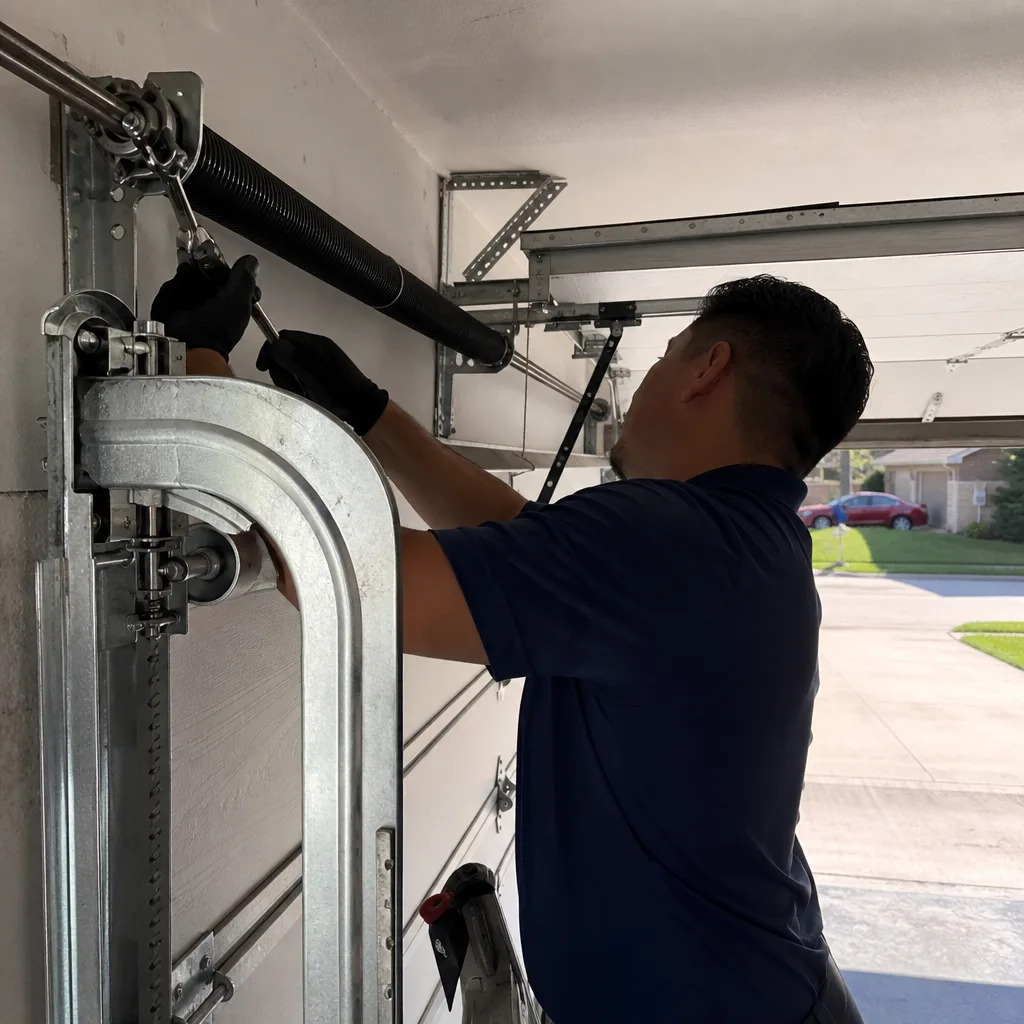 After
After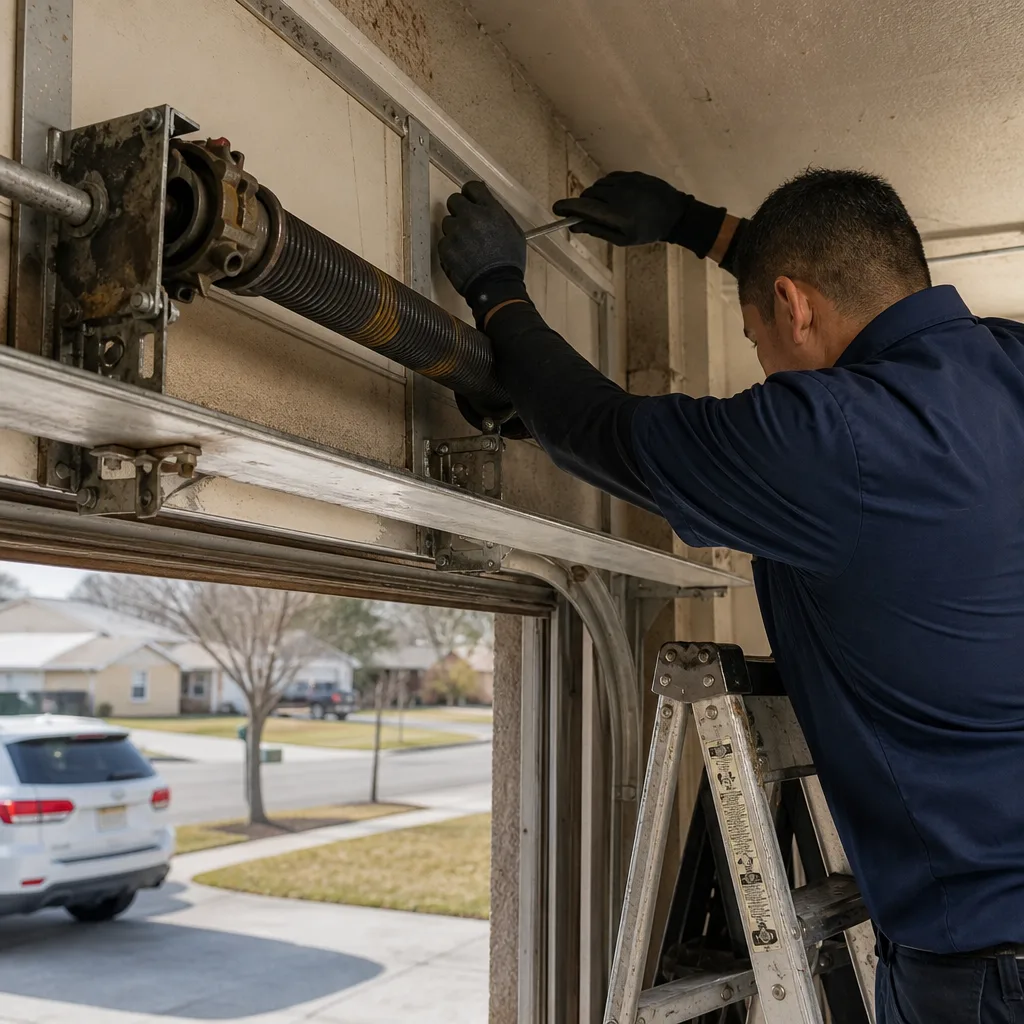 Before
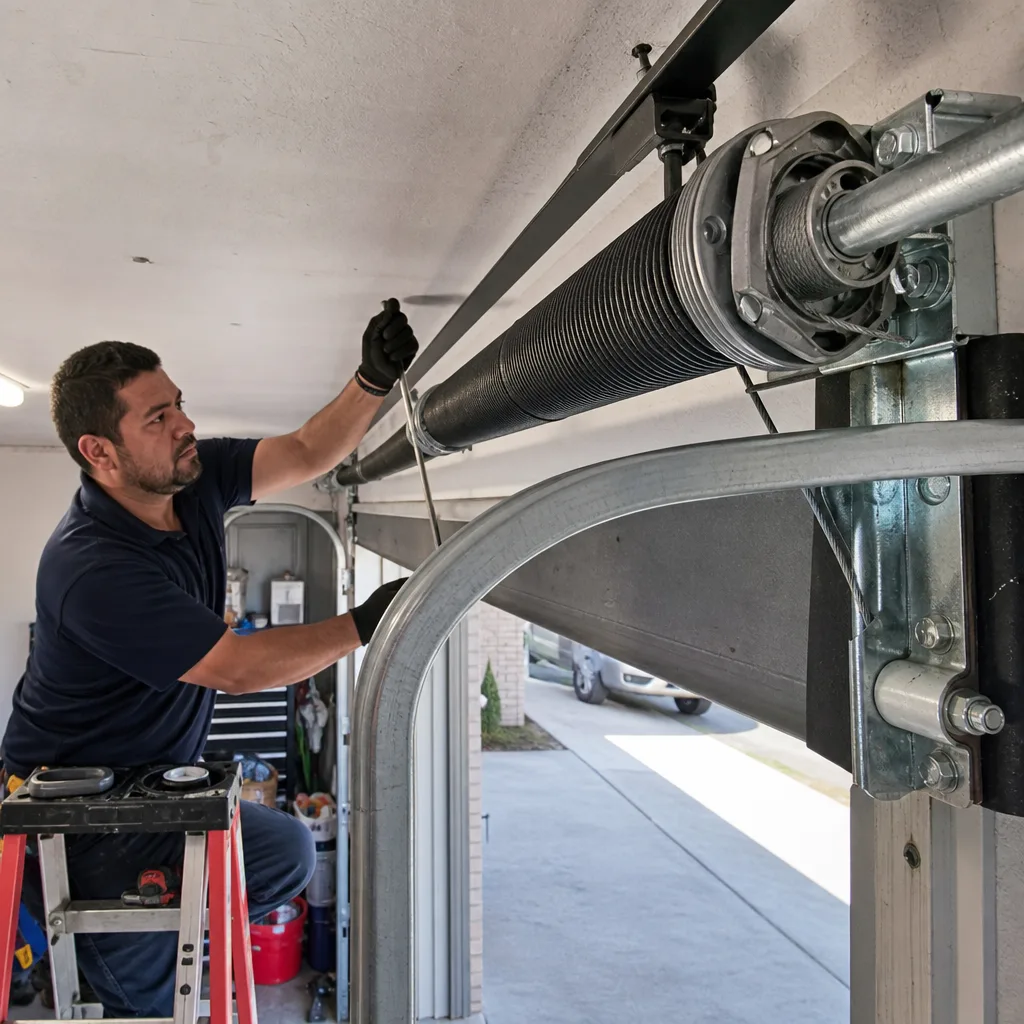 After
AfterDIY vs Professional Garage Door: The Baytown Homeowner’s Decision Guide
Most garage door injuries in Texas do not happen to beginners. They happen to capable homeowners who have changed their own oil, tiled their own bathrooms, and assumed a garage door repair belongs in the same category. It often does not. A standard torsion spring stores roughly 10,000 foot-pounds of torque when fully wound. That is not a metaphor. That is enough force to break a wrist, dislocate a shoulder, or worse. The tool required to release that energy safely, a winding bar set matched to the spring’s inner diameter, is not stocked at the Home Depot on Garth Road. In this guide, we’ll draw a clear line between what a Baytown homeowner can safely handle and what requires a trained technician, with specific attention to our coastal humidity, local code requirements, and the real cost of getting it wrong. For more guides & resources, see our blog.
Quick Answer
Most Baytown homeowners can safely handle lubrication, weatherstripping replacement, photo-eye alignment, and basic opener troubleshooting. Torsion spring replacement, cable repair, track realignment, and panel replacement should be performed by a licensed technician due to stored energy, structural load, and warranty implications. The dividing line is not skill level. It is stored mechanical energy and the specialized tools required to control it.
Table of Contents
- What Homeowners Can Safely Do
- The Physics of Torsion Springs: What Stored Energy Actually Means
- How Baytown’s Humidity and Heat Affect DIY Results
- Tasks That Look Simple But Are Not
- Warranty and Insurance Consequences of Self-Performed Repairs
- A Cost-Honest Comparison: Real DIY Savings vs. Callback Costs
- The Tool Investment Reality
- When to Call a Professional
What Homeowners Can Safely Do
There is honest work a homeowner can perform without special training or risk of serious injury. The common thread among these tasks: none involve stored tension, overhead load, or structural attachment to the door’s counterbalance system.
Lubrication and Basic Maintenance
Annual lubrication of rollers, hinges, and the opener chain or screw drive extends component life and reduces noise, as detailed in our Garage Door Repair Maintenance Checklist for Baytown Homeowners. Use a silicone-based lubricant, not WD-40, which attracts dust and hardens into abrasive paste in Baytown’s humidity. Apply sparingly. Wipe excess. This twenty-minute task, done each October before the temperature swings of winter, prevents most seasonal complaints we receive.
Weatherstripping Replacement
The vinyl or rubber seal at the door’s bottom and the stop molding along the jambs deteriorate faster here than inland. Salt air from the Ship Channel accelerates cracking. Replacement requires no tools beyond a utility knife and perhaps a pry bar. Match the profile exactly, or gaps will admit water during our spring storms.
Photo-Eye Alignment and Cleaning
Opener safety sensors, required since 1993, sit four to six inches above the floor on each track. When the LED indicator blinks or the door reverses immediately on descent, check for:
- Obstruction: leaves, spider webs, or accumulated dust on the lens
- Misalignment: the sending and receiving eyes must face each other squarely
- Sun interference: direct afternoon sunlight through a west-facing door can blind the receiver
Clean with a dry cloth. Adjust by hand until both LEDs glow steady. If alignment fails after several attempts, the bracket may be bent or the wire compromised. That is the boundary. Stop there.
Opener Remote and Keypad Troubleshooting
Battery replacement, reprogramming after a power outage, and clearing the memory of lost remotes are covered in every owner’s manual. Chamberlain and LiftMaster units, common in Baytown subdivisions built after 2005, typically require holding the “Learn” button for six seconds to erase all remotes, then reprogramming each individually. Genie Intellicode systems use a similar sequence with their “Program” button.
Manual Release Rope Operation
The red-handled rope hanging from the opener trolley disengages the door for manual operation during power outages. Pull firmly toward the door. To re-engage, run the opener until the trolley clicks into the carriage. This is emergency knowledge, not repair work, but every homeowner should know it.
What unites these tasks: if you make a mistake, the door does not fall, the spring does not unwind, and you do not need a tool you cannot buy locally.
The Physics of Torsion Springs: What Stored Energy Actually Means
We have heard every variation of the same question: “I am handy. I have replaced my own water heater. Why not a spring?” The answer is not about handiness. It is about energy storage and the mechanism of release.
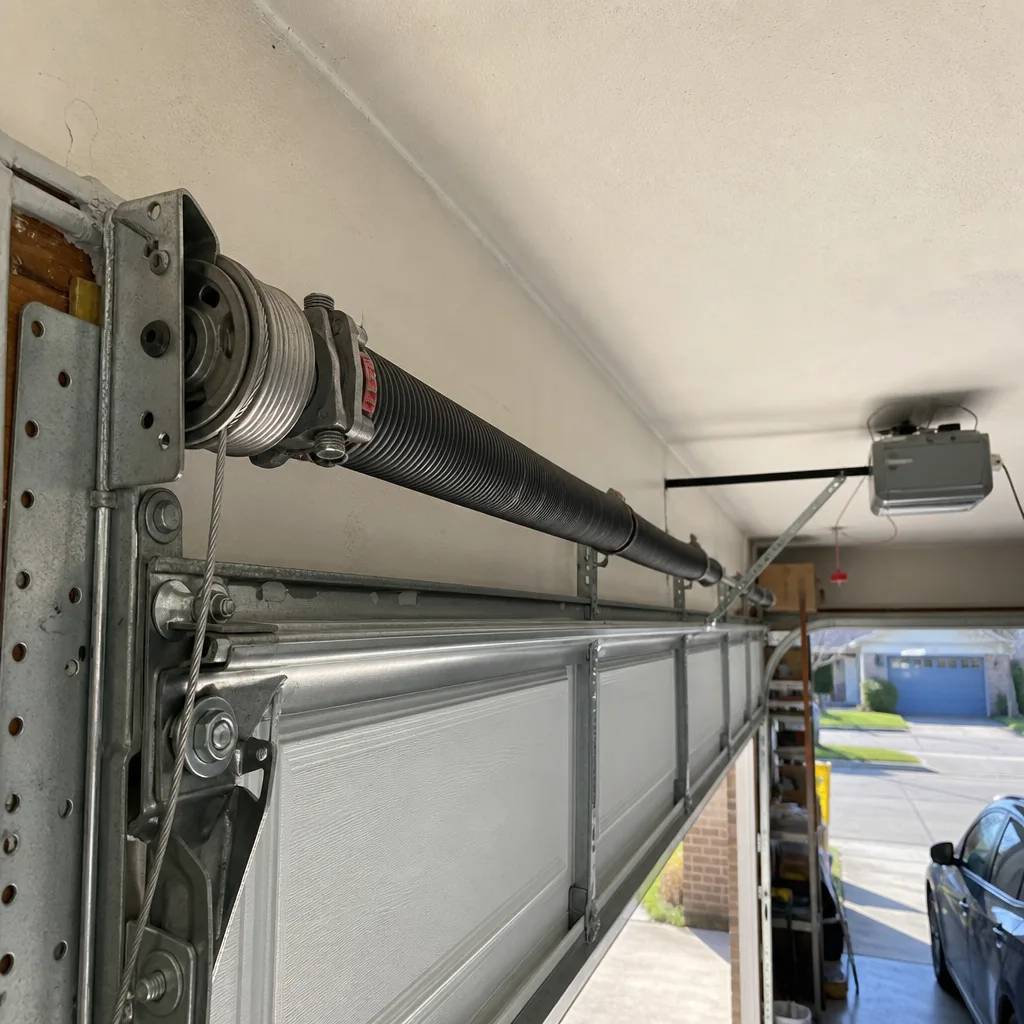
A torsion spring is a steel coil mounted on a shaft above the door. When the door closes, the spring winds tight, storing mechanical energy. When the door opens, the spring unwinds, providing most of the lifting force. The motor does not lift the door. The motor initiates movement. The spring does the work.
For a standard sixteen-foot wide, two-car garage door weighing approximately two hundred pounds, the spring must store enough energy to lift that weight through a seven-foot vertical travel. The calculation: roughly 10,000 foot-pounds of torque at full wind. To visualize, that is equivalent to dropping a pickup truck from one foot and catching it with your hands. The spring does not release this energy gradually when it breaks. It releases it instantaneously.
The danger is not the spring breaking while you watch. The danger is attempting to unwind a properly functioning spring to remove it. Two winding bars, solid steel bars inserted into the cogs of the winding cone, are required. Not screwdrivers. Not tire irons. Not adjustable wrenches. Winding bars. Inserted sequentially. Removed sequentially. One bar holding while the other moves. A single slip, a bar that does not seat fully, a moment of fatigue, and the stored energy releases through the bar in your hand.
We have seen the results in Baytown emergency rooms. A broken scaphoid. A dislocated elbow. A facial fracture from a bar that struck the homeowner after the cone stripped. These are not careless people. They are competent people who did not know that the tool they needed was not available at retail and that the technique requires supervised practice.
Extension springs, the older type running parallel to the horizontal tracks, carry less stored energy individually but are more unpredictable in failure. They are supposed to be contained by safety cables. In our inspection work across Baytown, we find those cables missing or improperly routed in roughly thirty percent of older homes, particularly in the historic districts near downtown and in unpermitted additions in the north end.
The physics do not care about your skill level. They care about whether you have the correct tools and training to manage the energy release. Most homeowners do not. That is not a failing. It is simply a fact of this particular trade.
How Baytown’s Humidity and Heat Affect DIY Results
Garage door maintenance written for national audiences assumes moderate climates. Baytown does not have one. Our location on Galveston Bay, combined with the industrial humidity from the Ship Channel corridor, creates conditions that invalidate standard advice.
Lubricant Selection and Application
The most common DIY error we correct is over-lubrication with the wrong product. Homeowners read “lubricate yearly” and apply petroleum-based grease or all-purpose spray to every surface. In our climate, this attracts airborne salt and particulates, forming an abrasive slurry that accelerates roller and hinge wear. We replace more corroded rollers in Baytown than in our inland service areas by a significant margin.
The correct approach: silicone-based spray, applied to roller bearings and hinge pins only, in a light film. Never lubricate the track itself. The rollers are designed to roll, not slide. Grease on the track collects debris and causes the door to bind.
Metal Fatigue and Corrosion
Coastal humidity accelerates metal fatigue in springs and cables. A spring rated for 10,000 cycles in a dry climate may achieve fewer here. The visible indicator, rust on the spring coils, often appears after internal degradation has already occurred. Homeowners who inspect annually and spot surface rust sometimes assume the spring is merely cosmetically affected. It is not. The rust indicates that the internal structure is compromised, and the spring is closer to failure than its cycle count would suggest.
Wood Door Swelling and Hardware Loosening
Wooden doors, still common in the Goose Creek and Cedar Bayou areas, absorb moisture seasonally. Hardware that was tight in January loosens by July as the wood expands and contracts. DIY tightening of track bolts and hinge screws is appropriate. However, the resulting misalignment, if the door has settled on its hinges, requires professional assessment. We measure reveal gaps and track plumb with specific tolerances. Eyeballing it usually makes the binding worse.
Opener Electronics and Thermal Stress
Garage without insulation, typical of older Baytown homes, expose opener motors to attic-grade heat. Circuit boards fail prematurely. Capacitors bulge. The DIY temptation is to replace the board or the entire opener. Before doing so, verify that the door itself is not overloading the motor due to spring degradation. A door that should require minimal motor effort, due to weakened springs, demands continuous high amperage and burns out the opener. Replacing the opener without addressing the springs guarantees repeat failure.
We see this sequence several times each summer: homeowner replaces opener in June, calls us in August when the new unit fails, and we discover springs that should have been replaced a year prior. The total cost exceeds what professional diagnosis and repair would have been initially.
Tasks That Look Simple But Are Not
Some garage door work occupies a middle category. It does not involve the catastrophic energy of torsion springs, but it carries risks of property damage, personal injury, or compounded repair costs that are not obvious.
Track Realignment
A door that rubs the stop molding or binds at a certain height suggests bent or misaligned track. The vertical track sections appear to be simple angle iron bolted to the jamb. Adjustment requires loosening multiple bolts, shifting the track in three dimensions while the door hangs on it, and retightening without introducing twist. The track must be plumb within a quarter-inch, parallel to its mate within an eighth-inch, and the horizontal sections must decline precisely toward the back of the garage so the door does not roll forward when open.
We have been called to Baytown homes where a homeowner’s track adjustment caused the door to jump the roller out of the track entirely, crashing to the floor or into a vehicle. The cost of that callback: typically a new bottom section, sometimes a new door, occasionally bodywork on a car. The time saved by DIY: two hours. The cost of the mistake: eight hundred to three thousand dollars.
Panel Replacement
Individual panels on sectional doors are replaceable. The procedure requires supporting the door in the open position, disconnecting the affected section from its hinges, and threading the new panel into place while maintaining cable tension. The risk: an unsupported door section can pivot on its remaining hinges, twisting the track or releasing cable tension asymmetrically. Clopay and Amarr panels are not lightweight. A sixteen-foot wide upper panel, even in steel with insulation, exceeds sixty pounds and is awkward to maneuver overhead.
Bottom Fixture and Cable Attachment
The bottom fixtures, where lift cables attach to the door’s lowest section, appear to be simple bolt-on brackets. They are not. These fixtures are under continuous tension from the spring system. Removing a bottom fixture without first securing the cable and releasing spring tension causes immediate, uncontrolled cable whipping. We have seen cables slice through drywall, shatter automotive glass, and lacerate forearms. The injury potential is second only to torsion spring work.
Spring Adjustment for Balance
A door that does not stay at half-open position or drifts closed indicates improper spring tension. The adjustment, a quarter-turn or half-turn on the winding cones, seems minor. It is not. Any interaction with the winding cone requires the same bar technique and hazard awareness as full spring replacement. Homeowners who attempt minor adjustments without training make the same errors as those attempting full replacement, with the same injury profile.
Weather Seal on Sectional Doors with Track Extensions
Bottom seal replacement on standard doors is straightforward. On doors with low-headroom track configurations, common in Baytown’s older garages with ceiling obstructions, the bottom roller is captive in a special bracket. Disassembly is required to access the seal retainer. Reassembly with incorrect roller placement causes the door to bind or jump track. The manual for your specific track type, not generic advice, is essential.
Warranty and Insurance Consequences of Self-Performed Repairs
Modern garage doors and openers carry warranties that many Baytown homeowners do not read until they need them. The conditions matter.
Manufacturer Warranty Limitations
Clopay’s limited warranty on residential sectional doors explicitly excludes damage resulting from “improper installation, alteration, or repair.” Amarr’s similar language voids coverage for “modifications not performed by an authorized dealer.” The authorized dealer requirement is specific. A homeowner who replaces their own bottom fixture, strips the attachment point, and later discovers a panel separation has no coverage for the resulting damage.
Opener warranties from Chamberlain, Genie, and LiftMaster vary in their DIY language. Some permit homeowner installation and permit the warranty to transfer to a subsequent owner. Others require professional installation for the full term. The distinction is in the fine print of the model-specific warranty document, not the general marketing materials.
Homeowner’s Insurance Considerations
Standard Texas homeowner’s policies cover sudden and accidental damage. They do not cover damage resulting from faulty workmanship, including your own. If a self-performed spring replacement fails and the door falls onto a vehicle, the auto policy may cover the vehicle under comprehensive, but the garage door damage and any structural damage to the home are likely excluded. The deductible alone often exceeds the cost of professional repair.
More significantly, injury to yourself or others during DIY work may not be covered under the liability portion of your policy if the work is deemed to exceed routine maintenance. We are not insurance professionals, and policy language varies. We raise the point only because homeowners rarely consider it until after an incident.
Permit and Code Compliance
Baytown’s building department requires permits for new door installation and structural modification, governed by Garage Door Permits, Codes & Inspections in TX: What You Need to Know. Repair of existing components typically does not require permitting. However, if a DIY repair results in damage that requires replacement of the door, frame, or electrical supply to the opener, the subsequent professional work must be permitted. Unpermitted work discovered at sale can delay closing or require retroactive inspection. We have provided documentation for real estate transactions where the seller’s handyman installation, performed without permit, required complete removal and reinstallation to satisfy the buyer’s lender.
A Cost-Honest Comparison: Real DIY Savings vs. Callback Costs
The economic argument for DIY garage door repair is straightforward on the surface. Parts are available online. Labor is your own time. The savings appear significant. The reality is more nuanced, and the comparison must include risk-adjusted cost, not just parts and labor.
Scenario One: Track Adjustment
| Approach | Cost Components | Total |
|---|---|---|
| DIY | 2 hours time, $0 parts (if adjustment only) | $0 out-of-pocket |
| Professional | Service call, 30-minute adjustment | $150-$220 |
The DIY savings are real if the adjustment is successful. Our experience in Baytown suggests a success rate for homeowner track adjustment of roughly fifty percent. The other half result in: door jumping track ($400-$800 repair), roller damage ($80-$150 additional), or misalignment that accelerates opener wear ($300-$600 premature replacement). Risk-adjusted DIY cost: $200-$400, with significant downside tail risk.
Scenario Two: Spring Replacement
| Approach | Cost Components | Total |
|---|---|---|
| DIY | Spring pair ($80-$140), winding bars ($40-$60 shipping, not locally available), 4 hours first attempt, injury risk unpriced | $120-$200 plus risk |
| Professional | Spring pair, labor, warranty, disposal | $280-$420 |
The apparent savings of $160-$220 must be weighed against: no warranty on self-installed springs, no recourse if sizing is incorrect, no assessment of related wear (cables, pulleys, bearings), and the unpriced but real risk of emergency room costs. We have replaced homeowner-installed springs that were the wrong wire size, the wrong length, or wound to incorrect tension, all within six months of the DIY attempt. Each required full re-replacement at professional rates, with no credit for the homeowner’s original parts purchase.
Scenario Three: Opener Replacement
| Approach | Cost Components | Total |
|---|---|---|
| DIY | Opener ($200-$500 retail), rail assembly, 3-4 hours, disposal of old unit | $200-$500 |
| Professional | Opener, installation, disposal, programming, warranty | $450-$750 |
The DIY savings here are most defensible, with two critical caveats. First, retail openers are not identical to professional-line models. The Chamberlain or Genie units sold at retail often lack the heavier-duty rail, the battery backup now required in some jurisdictions, or the extended warranty terms of dealer-supplied equipment. Second, installation requires precise door balance verification. A new opener installed on a door with degraded springs will fail prematurely. The professional installation includes this assessment. The DIY installation typically does not.
Our standing offer, Garage Door Repair in Baytown, includes a free second opinion on any written estimate. If you have received a DIY parts quote and want professional comparison, we will review it without charge.
The Tool Investment Reality
Competent DIY work requires correct tools. Garage door repair has several that are specialized and not economically justified for single use.
- Winding bars: Solid steel, specific diameter to match spring inner dimension. Available only through garage door supply houses or online. Cost: $40-$80. Use: one task, hazardous without training.
- Torsion spring winding cones and cogs: Not universal. Must match spring manufacturer. Incorrect fit strips the cone, causing uncontrolled release. Cost: included in professional spring price, $30-$60 if purchased separately.
- Spring winding and tensioning tools: Professional sets exceed $400. Not justified for homeowner use.
- Track plumb bobs and alignment gauges: Specialized to door industry tolerances. Standard carpenter’s levels are insufficient for the precision required.
- Cable pullers and come-alongs: Required for safe cable installation on heavier doors. Cost: $80-$150. Use: occasional, with significant hazard if misapplied.
The honest calculation: a homeowner who intends to maintain their own garage door through multiple cycles over many years might justify some of this investment. The typical homeowner, addressing a single failure in a home they have owned for fifteen years and plan to sell within five, will not. The tools sit in a drawer, the knowledge atrophies, and the next repair requires relearning from scratch.
We arrive with these tools on every truck. Our Mainspring Garage Door Co. home page describes our preparation. The name refers to the spring that carries the door’s entire weight. We built the company on the principle that the homeowner should never have to think about that spring.
When to Call a Professional
Call a technician when the repair involves any of the following: stored spring energy, overhead door weight, structural attachment to the home, electrical supply beyond plug replacement, or any task where failure would cause injury or significant property damage. Specifically: torsion or extension spring work, cable replacement or adjustment, track realignment, panel replacement on doors over eight feet wide, opener installation on unbalanced doors, and any repair where you are uncertain of the correct procedure.
We have served Baytown since 2016, and our roots in this trade extend back to 1984. Our technicians arrive with springs, cables, openers, and hardware on the truck. We state the flat price before any work begins. Our Garage Door Installation in Baytown and Garage Door Opener in Baytown pages detail our process. Mainspring Garage Door Co. offers free estimates in Baytown - call (936) 246-0813.
Common Mistakes to Avoid
- Using the wrong lubricant in coastal humidity. Petroleum-based products attract salt and particulates, forming abrasive paste that destroys rollers within two seasons. Use silicone-based spray only.
- Ignoring spring fatigue until failure. A door that opens slowly, reverses unexpectedly, or requires manual assistance is telling you the springs are degrading. Waiting for catastrophic failure damages the opener and risks the door falling.
- Adjusting track without verifying plumb and parallel. Eyeballing track alignment usually worsens binding. The door may operate initially, then jump track under thermal expansion or when a vehicle bumps the bottom edge.
- Replacing the opener without testing spring balance. New openers on weak springs fail within months. The motor overheats, the board fails, and the homeowner blames the opener manufacturer.
- Installing retail weather seal without matching profile exactly. Generic seal from the hardware store rarely matches the retainer channel. It pulls loose, drags on the floor, and admits water during Baytown’s heavy spring rains.
- Attempting spring work with improvised tools. Screwdrivers, tire irons, and adjustable wrenches do not seat in winding cones. They slip, strip, and release energy unpredictably. This is the most dangerous mistake we encounter.
- Neglecting to check safety cable condition on extension spring doors. In Goose Creek and older Baytown neighborhoods, missing or frayed safety cables are common. A broken spring without containment becomes a projectile.
Frequently Asked Questions
Professional torsion spring replacement in Baytown typically ranges from $280 to $420, including parts, labor, and warranty. Extension spring repair runs $180 to $320. The exact price depends on door size, spring type, and whether related components such as cables or bearings require replacement. We state the flat price before any work begins. Call (936) 246-0813 for a free estimate.
Torsion springs should be replaced as a matched pair even if only one has broken. The unbroken spring has experienced the same cycle count and is similarly fatigued. Replacing one guarantees asymmetrical lift, door binding, and premature failure of the new spring. Extension springs can sometimes be replaced individually if the surviving spring tests within specification, but paired replacement is still our recommendation.
Probably not for the door itself or structural damage. Standard policies exclude faulty workmanship, including your own. Auto comprehensive may cover vehicle damage if the door falls, but deductibles apply. We recommend verifying your specific policy language before attempting significant DIY work. For work we perform, our insurance and the 90-Day Done Right Promise provide clear recourse.
Coastal humidity accelerates metal corrosion, degrades rubber and vinyl seals faster than inland climates, and causes wood door swelling that loosens hardware seasonally. Lubricants must be selected for moisture resistance, not general-purpose suitability. Salt air from the Ship Channel corridor intensifies these effects in eastern Baytown neighborhoods. We adjust our maintenance recommendations accordingly for local conditions.
Watch for these indicators: the door opens more slowly than it used to, the opener strains audibly, the door does not stay at half-open position, visible gaps appear between spring coils, or surface rust is present. Any of these warrant professional inspection. We provide $89 Seasonal Tune-Ups that include spring condition assessment, balance verification, and lubrication with climate-appropriate products.
Yes. Our phones are answered by a live person 24 hours a day, including nights, weekends, and holidays. Most repairs are completed in a single visit because our trucks carry springs, cables, openers, and hardware for all major brands. We do not use answering services or voicemail for emergency calls. For urgent issues, call (936) 246-0813.
The Bottom Line
The DIY versus professional question for Baytown homeowners is not a test of competence. It is a test of accurate risk assessment. Lubrication, weatherstripping, photo-eye cleaning, and basic opener troubleshooting are within most homeowners’ capability and carry minimal downside. Any task involving stored spring energy, overhead load, or structural attachment deserves professional handling, not because homeowners are incapable, but because the tools and training required are specific to this trade and not economically justified for occasional use. Baytown’s coastal humidity adds a local variable that generic advice ignores. The cost of professional repair, when weighed against injury risk, callback expense, and warranty protection, is often lower than it first appears. We have built our practice on this principle for over four decades: state the price upfront, do the work right, and stand behind it without argument.
Written by Carl Dutton, Owner at Mainspring Garage Door Co., serving Baytown since 2016.